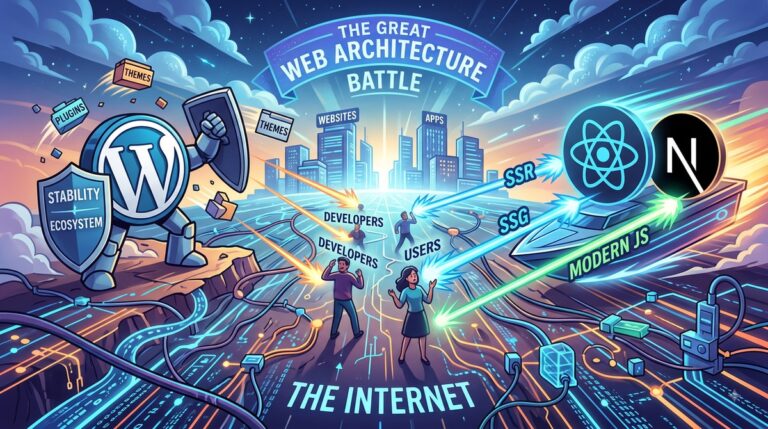
Why I’m still betting on WordPress in 2026 despite the rise of Wix, Squarespace, Shopify and AI-assisted development.
The conventional narrative around WordPress is becoming increasingly difficult to ignore: its market share is declining, while platforms such as Wix, Squarespace and Shopify continue to gain ground. At the same time, React, Next.js, Vue, Nuxt and other JavaScript frameworks are becoming increasingly common, particularly among larger and more technically sophisticated websites.
It would be easy to look at those numbers and conclude that WordPress is simply being replaced by newer technology.
I don’t think that’s quite what is happening.
What we’re actually watching is a collision between open technology, closed platforms and AI-assisted development. The long-term winner may not be obvious yet, but I’m still betting on WordPress in 2026.
WordPress is Like Buying A Car
I’ve always thought websites are a lot like cars. WordPress isn’t like like building a car from scratch. It’s more like buying a commercially manufactured vehicle built with stock parts and modifying it. The engine, the transmission, the electrical system already exists. There are standardized components, established repair procedures, and huge numbers of mechanics who already understand those parts and systems and offer enormous aftermarket service.
You can turn that vehicle into an e commerce delivery van. Or you can turn it into a sporty looking ticket sales machine! Whatever you build, you can still replace components. If your mechanic moves away, no problem. Plenty of other mechanics can still work on it.
That is one of WordPress’s greatest strengths. A site built today doesn’t need the original developer to remain around. Any other competent WordPress developer can come along and inspect it, understand its architecture, and maintain it.
That’s not guaranteed with other technologies.
Closed Platforms Are More Like Leasing The Car
Wix and Squarespace are closer to leasing a vehicle. You get something that is turnkey; convenient and predictable. You don’t need to understand how it works. You don’t need to go looking for a mechanic because they look after things.
But you never truly own the car.
The dealership can change the engine, raise the lease price, change the dashboard, or discontinue a feature. And there’s not a dang thing you can do about it.
Your website may contain years of accumulated content over pages, blog posts, images. The forms you created for capturing client information. Your e-commerce data. Your analytics. All the tweaking that you did on your SEO. This is all your data. And it might be in a format you cannot extract or export. That means you might not be able to import it somewhere else.
That convenient and predictable ease of use versus a potentially difficult migration can make the transistion more costly than just a subscription would indicate.
WordPress Usage Trends
As of August 2026, WordPress powers 41% of all websites globally. This is a dip from its peak of over 43% in early 2025. Even with this decrease, WordPress still powers a significant potion of the internet.
When you focus just on content managment systems (CMS), WordPress has almost 60% of CMS market share. The next three competitors, Shopify, Wix, and Squarespace are at best 13% of overall internet market share and 17% of CMS market share.
Shopify / Wix / Squarespace have all seen growth in 2026. These CMS platforms represent 7.5,%, 6.1%, and 3.2% respectively.
We’ve seen some penetration from open-source JavaScript frameworks like React, Vue, Next.js, etc.. This represents a very small segment of market share; however, this smaller market share focussed more on high traffic websites. For example, Next.js represents 3% of all websites; however, when you focus on the top 1000 websites, Next.js enjoys a 22% share.
This doesn’t represent people leaving WordPress in droves. However, it does indicated more people are paying attention to critical parts of infrastructure and stack on more sophisticated business websites.
Even with the penetration of frameworks like Next.js, about 22% of sites still use WordPress as their backend CMS. That means these technologies are not gaining ground at the expense of each other. They can definitely be used in a complimentary manner!
(W3Techs usage statistics, accessed August 13, 2026.)
AI (Kind Of) Changes the Equation
AI can dramatically reduce the amount of specialized knowledge to create a website. You can build React application, Next.js/Vue/Nuxt sites, static sites… even complicated architectures like Cloudflare workers. A few years ago, you would have needed to have an extensive skill set to handle all of this on your own. You would need to understand hosting operating systems, PHP, databases, SSL security certificates, backups, and security patching. That’s a lot of stuff you need to know.
AI is getting better at better at producing something that works, most of the time. But something that “works” (a minimum viable product) isn’t the same thing as being maintainable.
This is where my previous analogy of a car gets interesting. I can ask the world’s smartest engineer to design me a vehicle from scratch. I get a car that looks sexy but also oddly reminds me of every other vehicle.
What happens if you need to service that car several years down the road? Another mechanic or engineer might open the hood and go, “what the f…?!”. If your mechanic can’t understand what he’s looking at, what happens? Does the mechanic just fix the individual issue or build an entirely new car that looks almost exactly like the original car. That is quite often what AI does.
The Hidden Cost of AI
If you were to listen to the CEOs of all the AI companies out there, AI should make your developers incredibly productive.
But that’s not what’s happening. A developer can spend a whole bunch of time explaining the existing architecture and provide lots of additional context. But the developer’s also there to keep an eye out for inexplicable regressions of code and half-remembered hallucinations. Quite often something else will break while AI is allegedly fixing the first problem.
There is a point where the developer stops developing and starts managing AI’s understanding of the programming problem. AI productivity is highly dependent on the quality of the existing architecture and the developer’s ability to supervise it.
Can I maintain what I have built? Can somebody else take it over? What’s the cost to move away from this technology? What happens when the AI I am using changes in terms of model or pricing? Often people don’t think about this, and that potentially leads to costly maintenance or years and years of technical debt.
You may save some money in the short term using AI, but you should consider what it might cost you in the long term as well.
Why AI May Make Maintainability More Valuable
As I said at the outset I’m still betting on WordPress in 2026.
It’s often said that people dislike change. That is doubly true for business owners and for technology. It’s boring. And boring can be tremendously valuable in business. It means minimizing costly surprises.
WordPress is constantly maintained to ensure that it is stable and secure. It has been around for over two decades. And has an enormous install base. That means there’s lots of hosting infrastructure out there that support it. That means there are plugins and documented APIs to extend it, and migration tools to move it. It’s predictable. And you can find an enormous number of developers that work in that predictable space.
WordPress provides a level of stability and a known product.
The Bigger Lesson
The cheapest way to create something isn’t necessarily the cheapest way to own it for ten years. That’s the part of the current technology conversation that gets lost in all this AI noise.
A website isn’t finished when it launches. It needs to be maintained. It needs to be secured. It occasionally needs to be migrated. Companies change. Products are discontinued. Eventually somebody has to work on the website.
The technology that wins, isn’t necessarily the technology that builds the website the fastest. It may depend on your choice to optimize for convenience or ownership. It may be the technology that leaves the savvy business owner with something another competent developer can still understand and maintain ten years down the road.
And that is a surprisingly strong argument for boring, open, standardized WordPress in 2026, baby!