
Website basics every small business owner needs before leaning on AI
There’s a pattern I keep seeing. Small business owners want a website, and they want it cheap. For years, that meant online marketplaces where you can get web design help for very little money. Sometimes that works out and you get great value. But as a web developer who has to tries to a living at this, I’ve always seen the model as a race to the bottom on price. I have a hard time believing that taking the least money possible for your craft is good for you in the long run, and it isn’t always good for the client either. The old saying applies: you get what you pay for.
Now AI is available for free (or at least fairly inexpensive), and it’s quietly taking the place of cheap outsourcing as the cost-cutting move of choice.1 Different tool, same trap. Both are a false economy.
The common thread is knowledge. Whether you hire the cheapest bidder or hand the job to a chatbot, you’re trusting something to fill in what you don’t know. And you can’t prompt AI about what you don’t know exists.
AI has always felt like a solution in search of a problem. People say it “democratizes creativity,” and I’ve always struggled with that. It doesn’t give you a skill set. It spits out something based on millions of examples it has already seen. Nobody is being creative here.
Creativity was never undemocratic before AI, as it has always been accessible to anyone willing to put in the hard work, discipline, and skill development.
Think about it this way. AI has likely been trained on petabytes of medical data. Does that mean AI democratizes surgery? Are you good with me doing a quick appendectomy or open-heart surgery on you after I got a list of pointers from ChatGPT? Didn’t think so.
Your website is your business
A website represents your business. It has a job. It’s either selling product for you or capturing leads for your services. Outsourcing your success to whoever or whatever is cheapest isn’t a plan.
A website isn’t one thing
Anyone can get AI to cough up a website of sorts. That’s a small part of the job. A website is multidisciplinary: design, writing, hosting, domains, email, security, search, payments, and the legal bits that come with collecting people’s information. If your site is doing any heavy lifting, you’re juggling most of those at once. Then there’s the stuff nobody sees, like making sure search engines can find you and your email actually lands in your potential clients’ and customers’ inboxes instead of their spam folder. The site is one piece of a bigger machine.
Dunning-Kruger on tap
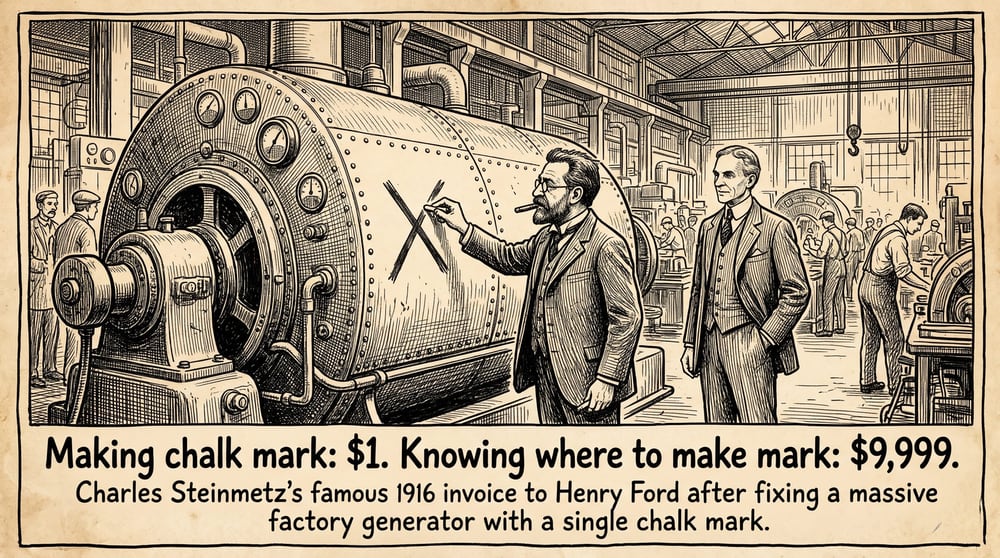
Here’s what worries me most. A lot of people try AI, get a decent-looking result in twenty minutes, and suddenly think they know it all. They don’t. AI creates blind spots, because you can’t prompt it about what you don’t know exists. It will happily answer the question you asked. It won’t tell you the question you should have asked.
An expert knows what to ask. Expert advice can be a great investment, saving you money in the long run.
What you actually need to know
You don’t need to become a developer. You do need to know what questions to ask, whether you’re asking a chatbot, a freelancer, or me. This applies on any platform, whether it’s WordPress, Wix, or Squarespace. Basics are basics. Here’s a starting list:
- Domain and DNS: Who controls your domain, and where do your records point? If you don’t know, you could lose your site and email in one bad afternoon. A domain name helps build trust with clients, and helps branding/marketing.
- Email deliverability: Are SPF, DKIM, and DMARC set up? If not, your emails may be landing in spam, and you’d never know. Email from your domain also helps to build trust in dealing with clients.
- Backups: Where are they, how often do they run, and have you ever tested a restore? Does it support migration?
- Content: Can you easily export/migrate content to another blog or platform? Can you easily manage digital assets like images and video? What is the image workflow like?
- Security and updates: Who’s keeping the platform, themes, and plugins patched? Who manages and monitors licenses? What security is in place to protect the site?
- Search visibility: Can search engines crawl and understand your site? Does each page have a clear purpose and a clear audience? What about OG for social media? Schemas for special content? How can you optimize for AI overviews and zero-click results?
- Speed and mobile: Does it load fast on a phone over a mediocre connection? How easily can you use a content distribution network (CDN)? Will your site scale with more traffic?
- Ownership: If your developer, platform, or AI tool disappeared tomorrow, could you still get at your content and your site?
- Payments and data: If you take money or collect personal information, is it handled securely and legally? Are you selling memberships, subscriptions, products, services, tickets?
Take this list into any conversation with AI or a human, and you’ll get better answers either way. That’s the point.
AI as a co-pilot: when to use it, and when not to
I’m not telling you to avoid AI. With more and more model context protocol (MCP) support and skills showing up across platforms, AI has become a genuinely useful co-pilot. The key word is co-pilot. You’re still flying the plane.
Good uses:
- Drafting and brainstorming
- Explaining a concept you’re stuck on
- Speeding up repetitive tasks once you understand what they do
Bad uses:
- Making decisions you don’t understand
- Handling money, security, or legal obligations without a human checking
- Replacing your own voice, experience, and specifics, which is what sets you apart from the competition
A good rule: ask it to explain why, not just what. If it can’t, or you can’t follow the answer, that’s a flag.
Why I work with WordPress
The basics apply everywhere, but WordPress is my platform of choice, and a big part of the reason is accessibility. It’s mature, flexible, and widely supported, with a huge community and ecosystem behind it. You’re never stuck with one developer, one agency, or one vendor. It’s built to grow with a business instead of boxing it in. And MCP provides a safe way for beginners to use AI to manage a website, and deep enough for when you need heavy lifting.
I built this site for small business owners and community leaders who want to go beyond “I need a website”. I try to provide the how, what, and why of what it really takes to build and maintain a website and online presence. I want you to know what you are doing and why you are doing it, because you can’t prompt AI about what you don’t know.
Use what’s here to learn the ropes, or to check my work against what you already know. If you want a hand getting comfortable running your site yourself, I can train you. If you’d rather not deal with it at all, schedule a discovery call to see how I can help.
- Fiverr has seen an average 25% reduction in buyers and revenue from Q3-2025 to Q3-2026: FIverr’s Q3 2026 results ↩︎